
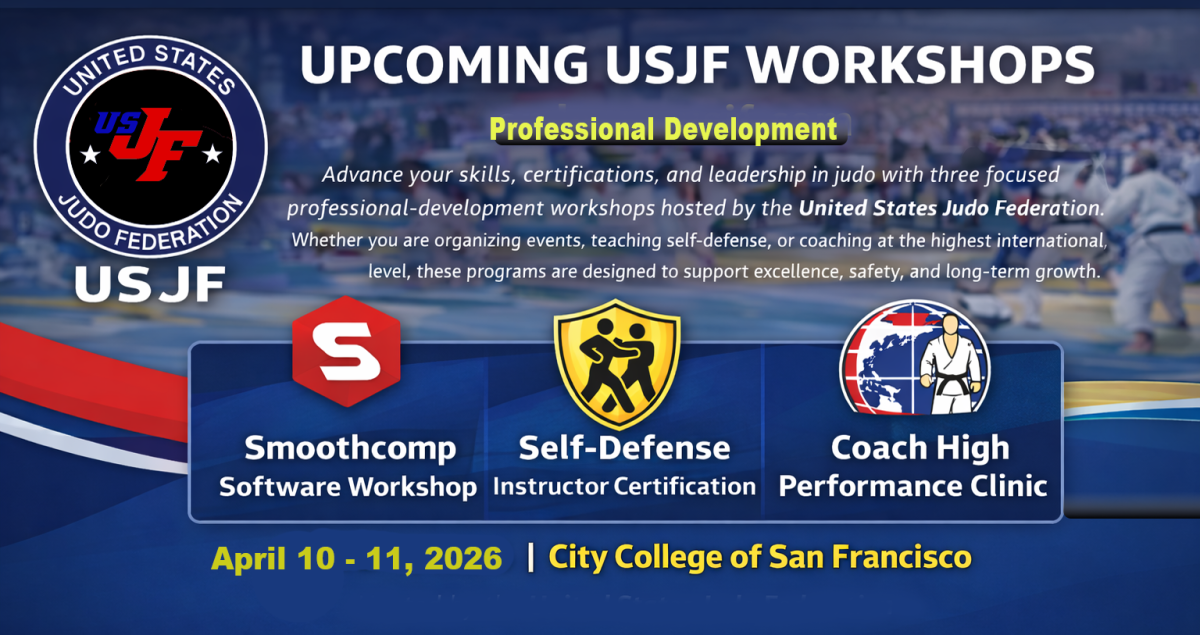
USJF Coach High Performance Workshop
Preparing Coaches for International Team Leadership
For new coaches especially those aspiring to high-performance regional, national or international team roles, the most relevant professional development topics consistently fall into six core areas. These areas form the foundation of effective coaching at the regional, national, and elite level and are the focus of the USJF High Performance Workshop.
Participation in the USJF High Performance Workshop is required for USJF coaches who wish to be considered for selection as a USJF International Coach for the 2026 Prague and Paks Junior European Cups and associated international training camps in Prague and Hungary.
For more information, please contact USJF Coach Education Chair, Hannah Tsutsui, at usjfcoach@usjf.com
Workshop Schedule
- Friday, April 10 – CCSF Wellness Center
- Classroom 103: 6:00 pm to 9:00 pm.
- Saturday, April 11 – CCSF Wellness Center
- Classroom 103: 9 am to 12:00 pm
- Dojo – Rm 205 (On mat session) 2:00 pm to 5:00 pm
For more information contact: Mitchell Palacio, m.palacio@usjf.com
Smoothcomp Registration
Clinic Highlights
-
International coaching standards and expectations
-
Athlete preparation for elite and international competition
-
Training structure, periodization, and performance analysis
-
Leadership, communication, and professional coach conduct at major events
Built for coaches pursuing international team roles
Emphasis on excellence, professionalism, and long-term athlete development
Foundations of High Performance
1. Foundations of High-Performance Physiology (Coach-Practical)
1. Foundations of High-Performance Physiology (Coach-Practical)
New coaches do not need to become physiologists, but they do need to understand what they are seeing on the mat and how it impacts performance.
Key topics include:
-
Lactic acid vs. fatigue (clearing common misconceptions)
-
Work-to-rest ratios in randori and competition
-
Recovery strategies between matches and training days
-
Recognizing signs of overtraining vs. underpreparation
2. Training Methodology & Periodization
2. Training Methodology & Periodization
This section focuses on how to organize training so athletes peak at the right time without sacrificing technical quality or long-term development.
Key topics include:
-
Structuring a training week (technical, tactical, physical)
-
Short-term vs. long-term planning (daily → seasonal → quadrennial)
-
Peaking for competition
-
Adjusting intensity while preserving skill quality
-
Managing mixed ability levels within one training group
3. Motor Skill Acquisition & Learning
3. Motor Skill Acquisition & Learning
Understanding how athletes learn is just as important as what they learn.
Key topics include:
-
Skill acquisition vs. skill performance
-
Blocked vs. random practice
-
Constraints-led training in judo
-
When to correct—and when to let athletes struggle
-
Teaching transfer from drills → randori → competition
4. Competition Coaching & Decision-Making
4. Competition Coaching & Decision-Making
High-level coaching requires calm, informed decisions under pressure.
Key topics include:
-
Match analysis: gripping patterns, tempo, and scoring trends
-
Coaching between matches, what actually helps
-
Tactical adjustments mid-tournament
-
Managing athlete emotions and arousal levels
-
Coach behavior standards on the IJF stage
5. Video Analysis for Performance Improvement
5. Video Analysis for Performance Improvement
Video is a powerful tool when used correctly.
Key topics include:
-
What to look for in competition footage
-
Identifying patterns in gripping, movement, and attacks
-
Opponent scouting fundamentals
-
Turning video insights into actionable training goals
-
Avoiding information overload for athletes
6. Professionalism & Long-Term Athlete Development
6. Professionalism & Long-Term Athlete Development
International coaching is about more than medals, it is about building careers and protecting athlete welfare.
Key topics include:
-
Coach roles within a national delegation
-
Communication with athletes, staff, and officials
-
Ethical boundaries and athlete welfare
-
Long-term athlete development models
-
Building athletes for sustainable careers, not just tournaments
Sports Psychology with Dr. Michael Buckle
Sports Psychology
Presenter: Dr. Michael Buckle
It is valuable to begin with an overview of applied sport and performance psychology and how it can support both coaches and athletes.
Presentation
-
Overview of applied sport and performance psychology
-
Core mental skills training commonly used with athletes
-
Mental health and clinical issues frequently addressed in sport settings
-
How and where to identify a qualified sport psychology consultant
-
Case study: Working with an Olympic-level athlete
-
Case study: Supporting an elite-level coach—because coaches benefit too
-
Question and answer session
Referee Tendencies & Continental Styles
Not all referees officiate the same way.
You should know:
-
European referees often emphasize gripping initiative.
-
Asian referees may be quicker on technical scoring.
-
Some are stricter on passivity.
-
Some allow longer grip exchanges before shido.
Presenter: Dr. Diba Mani, IJF – A Referee
On Mat Training Session: Dr. Diba Mani - IJF A Referee
On Mat Training Session
3 hour Training Session – 2:00 pm to 5:00 pm